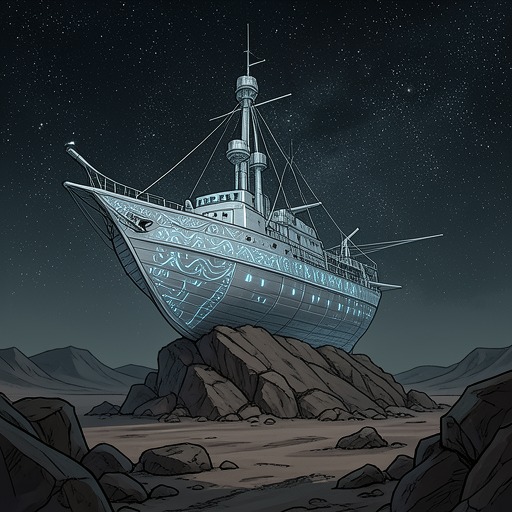
Landing of the Invincible on Regis III
The InvincibleLanding of the Invincible on Regis III is the expedition’s decisive threshold event: the class II cruiser reaches the planet, comes to a definitive standstill, and begins its ground program under heightened security. What appears at first to be a successful arrival soon becomes the foundation for a scientific and military confrontation with a world whose biological history, metallic strata, and autonomous mechanical life resist human categories. The landing gives the crew access to Regis III, but it also places them inside an ecological and evolutionary system they do not understand.
Approach to Regis III
The Invincible is the largest vessel in the fleet stationed at the base in the Lyra constellation, carrying a crew of eighty-three men. During the relatively short journey, the crew is not placed in full hibernation; instead, their sleep is deepened while their body temperature remains above fifty degrees. Only automatons remain active on the bridge. As the ship approaches a sun scarcely hotter than a regular red dwarf, the annihilation reactor is shut down, ending the vibration of the shaft of light that had driven the vessel forward. The cruiser continues at nearly the speed of light, inert and silent, apparently deserted while its human occupants sleep.
The arrival is therefore framed by an unusual contrast between enormous technological power and near-total stillness. The ship crosses interstellar space as a functioning machine without visible human agency, then has to convert that silent momentum into a controlled planetary descent. The transition from photon sequence to landing is not merely logistical. It marks the point at which the expedition’s abstract knowledge of Regis III must confront the planet’s material conditions.
The Landing and Ground Procedure
During descent, the ship’s engines are cut after the level indicators register zero. The emergency jets remain ready while the crew waits for the ground to settle. Superheated nozzles contract with hoarse mechanical sounds, and a reddish cloud of sand falls away from the vessel. The blunt top of the cruiser emerges first, followed by its sides, blackened by atmospheric friction until they resemble ancient rock, and then its double-plated hull. When the dust finally clears, the Invincible is completely still, as if it has become part of the planet and is turning with its surface beneath a purple sky.
The landing is immediately recognized as more than a routine arrival. When a crew member asks whether regular procedure should begin, the star captain, looking up from the log book where he has recorded the customary landing symbol, the time, and the name Regis III, rejects the ordinary protocol. The expedition will begin with Degree Three Ground Procedure. That decision changes the meaning of the landing from simple arrival to a defensive occupation of the immediate surroundings.
Rohan then moves to the control consoles and issues the order over the intercom. The energobots are to be prepared, shield batteries activated, force-field technicians sent to their stations, and the rest of the crew placed at their assigned positions. His voice carries suppressed disapproval, and he imagines the sleeping crew awakening into astonishment and anger as they realize that the mission has begun under exceptional conditions. The announcement makes the ship’s landing a collective psychological shock as well as a technical operation.
First Interpretations of the Planet
Once on Regis III, the expedition confronts a planet that does not conform to familiar expectations of habitability. Rohan and the other specialists observe that the world appears extremely old, perhaps six billion years, while its sun is long past its prime and close to becoming a red dwarf. Insolation outside the equatorial zone is poor, and the polar ice may be several miles thick. The absence of visible life on land becomes one of the first major puzzles of the landing site.
Rohan proposes that life might be concealed beneath the ocean and that underwater beings could have developed a civilization below the surface. The idea is presented while the men study a large, incomplete Mercator projection based on unmanned probes from the previous century. The map records continents, seas, polar icecaps, craters, and the landing point at eight degrees north, but it does not provide the detail needed to make the planet legible. The captain dismisses the aquatic-civilization theory as implausible, arguing that intelligent aquatic beings would have attempted to conquer the land. The crew decides to remain in place and observe rather than immediately commit to a single explanation.
The evidence later complicates this early uncertainty. Geological investigations reveal ruddy-black layers of material that are neither geological nor planetary in origin. The material may consist of metallic fragments deposited millions of years earlier, perhaps by a nickel-iron meteor that exploded in the atmosphere and fell as a burning rain. Over immense spans of time, the fragments oxidized and reacted chemically with the environment, becoming brown-black and dark-crimson seams within the sediment.
Further drilling reconstructs a deep history of repeated terrestrial life and extinction. Fossils show that primitive reptiles once inhabited the planet’s jungles, while plants and animals disappeared abruptly around a hundred million years ago, possibly after a nearby nova. Life later returned in new forms, but the planet never produced mammal-like organisms. After another, more distant stellar explosion, traces of plants and animals became increasingly rare, while compressed material containing antimonite, molybdenum oxide, iron oxides, and salts of nickel, cobalt, and titanium became more common.
The metallic layers date from roughly eight to six million years ago. Some contain localized radioactivity, suggesting violent nuclear reactions, yet the total radiation was too limited and too widely distributed to explain the extinction of terrestrial life. The resulting pattern is more disturbing than a simple catastrophe: land life disappeared over millions of years as metallic strata emerged, but radiation does not account for the transformation. At a depth of about seventy feet, investigators find rusted forms resembling broken microscopic mechanisms, strengthening the suspicion that the planet’s mineral history is connected with technological remains.
From Expedition to Confrontation
The landing enables the excavation of ruins and the collection of samples, but those scientific activities also expose the expedition to forces it has mistaken for an enemy with intention. The crew’s efforts to interpret the ruins culminate in the recognition that the supposed city was not a city at all, while questions about what should be reported to the commander reveal the growing gap between observation and explanation. Regis III is being mapped, classified, excavated, and treated as a source of evidence, yet every new fact makes the planet less like an archaeological site and more like an active system.
A biologist later states the central ecological contradiction plainly: there is life in the ocean, but not on land. The land organisms found by the expedition are more than five million years old; after that period, terrestrial life was wiped out. This distinction supports the hypothesis that a rocket from another system may have arrived millions of years earlier and introduced mechanisms whose subsequent evolution altered the continents without requiring conscious design.
The emerging interpretation is that the mechanical formations are inanimate products of a long evolutionary process. They are perfectly adapted to Regis III, capable of dispersing, regenerating, and multiplying after part of their mass is destroyed. They attack opportunities rather than following a recognizable strategic plan, obstruct communication, and treat anything intelligent or alive as something to be destroyed. Their apparent hostility is therefore not necessarily the expression of reason or malice. It may be the behavior of a planetary force that has survived for millions of years.
This conclusion collides with the expedition’s military logic. Horpach insists that the crew cannot return with hypotheses alone and wants samples of the flying mechanical fauna brought aboard the Invincible so that the facts can be established. The opposing view is that the formations cannot be defeated by ordinary strategic thinking: they can scatter when struck, move elsewhere, regenerate, and remain unaffected by conditions lethal to biological life. Even an antimatter strike cannot annihilate all of them. The suggested response is not revenge for the Condor or its crew, but withdrawal from a conflict in which the adversary is less an opponent than an ecological process.
Consequences and Significance
The consequences of the landing extend far beyond the safe placement of the ship on the surface. Nineteen days after arrival, while mining teams work among the metallic seams, a storm far more violent than terrestrial storms erupts. Dense black clouds, incessant lightning, swollen waters, and a wall of darkness over the ocean force the teams and their automatons back beneath the main force field. Tiny black metal specks appear on the sand afterward, linking the planet’s weather and its mechanical phenomena in a way the crew cannot dismiss as coincidence.
The confrontation reaches its most destructive expression when the Cyclops battles the black cloud. The vehicle reverses toward the ravine entrance, apparently trying to reach more open terrain as fire, smoke, cloud remnants, and falling rock become impossible to distinguish. A burst of antimatter then converts the surrounding air, debris, steam, gases, and smoke into extremely hard radiation, splitting the ravine and enclosing the cloud in an annihilating blast. The Invincible, forty miles away, rocks from the impact; seismic waves cross the desert, nearby equipment shifts, and a wave of heat and sand reaches those sheltering beneath vehicles. The landing site has become a position from which the crew witnesses planetary-scale violence.
The event also produces a moral reversal in Rohan. Looking back on the expedition’s losses and its confidence in cannons and sensors, he recognizes that the crew acted rashly and trusted its destructive technology too much. He rejects the language of conquest at any cost and heroic human survival when that language disguises errors that have already cost lives. His revised understanding of galactocentrism is not a license to search only for beings resembling humanity, but an obligation not to interfere with forms of existence that have established their own equilibrium over millions of years.
For that reason, the landing is both an achievement and an indictment. The Invincible successfully reaches Regis III and activates its ground procedure, yet the arrival does not place the planet under human control. It reveals instead that the expedition has entered a world with its own deep history, boundaries, and survival logic. The crucial question becomes not whether humanity can arrive, excavate, sample, or attack, but whether it has earned the right to treat every unfamiliar existence as an obstacle. The landing’s decisive legacy is this change in scale: a mission that begins as exploration becomes a test of whether human intelligence can recognize a nonhuman order without trying to destroy it.